
Is SEO Dead? (I Wouldn’t Bet Your Business On It) | Over the Bull®
Every few years, someone confidently declares that search engine optimization has died. It’s an easy claim to make, because the digital world shifts so fast that anything more than a few months old can feel obsolete. But here’s the truth:…
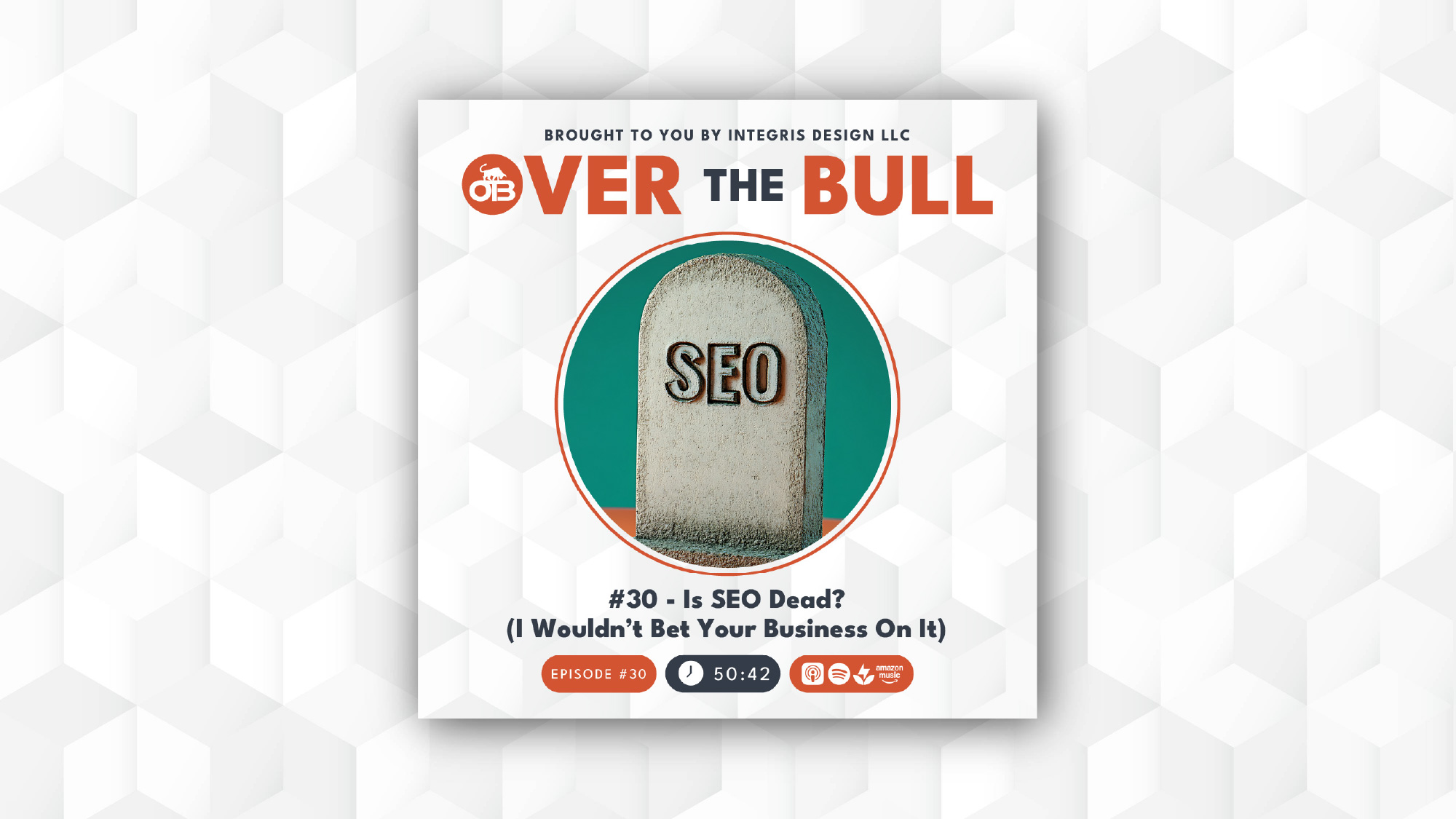
Every few years, someone confidently declares that search engine optimization has died. It’s an easy claim to make, because the digital world shifts so fast that anything more than a few months old can feel obsolete. But here’s the truth: SEO isn’t dead. It’s just growing up. The way people search has changed, the tools have changed, and the systems ranking that information have changed, but the principle underneath it all hasn’t. The purpose of SEO has always been the same—to make your business more visible and more credible online.
The idea that SEO no longer matters comes from frustration. It’s harder now. The rules are more complex, the competition is tougher, and the line between organic and paid visibility is constantly blurring. But if you step back from the noise, you can see that what’s happening isn’t a death; it’s an evolution. The internet is maturing, and so are the expectations for what credible online presence looks like. The same way a coach reminds players that winning games still comes down to blocking and tackling, modern marketing still comes down to fundamentals—clarity, consistency, and credibility.
The Fundamentals of Modern Visibility
Vince Lombardi used to begin every football season by holding up a football and saying, “This is a football.” It sounds almost ridiculous, but it worked because it re-centered the team on fundamentals. SEO needs the same reminder. When people say SEO is dead, what they really mean is that the shortcuts they used to rely on don’t work anymore. Keyword stuffing, link farming, and recycled blog posts once fooled search engines into thinking a site was relevant. Now those same tactics get you penalized. The foundation hasn’t changed—you still need to prove relevance, authority, and trustworthiness—but how you prove it has.
At its core, SEO is about credibility. Every algorithm update, every AI advancement, and every new platform reinforces that simple truth. Search engines and AI models are in the business of trust. Their success depends on delivering accurate, useful information. That means your success depends on being seen as a reliable source of that information. When Google or ChatGPT encounters your brand, the question they’re asking isn’t, “Is this keyword present?” It’s, “Can we trust this?”
Building Real Credibility
Credibility online is earned through consistency and authenticity. It comes from having a website that’s fast, informative, and structured around the user’s needs. It comes from accurate listings, reviews, and engagement that prove your business exists in the real world. It comes from being cited or mentioned by other credible sites. Every detail matters because every signal adds up.
The challenge is that credibility now extends beyond traditional search engines. It includes how AI systems perceive your business, how they summarize information, and how they recommend brands. That’s why SEO today includes optimizing for visibility across both traditional search and emerging AI-driven platforms. It’s no longer enough to rank on Google. You need to be recognized by the tools people use to talk to Google.
The Problem With Automation
The fastest way to destroy credibility is to automate what should be human. There’s no shortage of agencies promising quick results by letting AI tools write content without human review. On the surface, it looks efficient—your blog fills up, your keywords are present, and your analytics show activity. But what happens behind the scenes is damage. Search engines detect low-quality, repetitive, or non-human content and begin to devalue your entire site.
This doesn’t mean AI is the enemy. In the right hands, it’s one of the most valuable tools available. AI can research topics, summarize data, or help identify patterns in your audience’s behavior. What it can’t do is replace the human insight that gives your brand authenticity. The best-performing content combines technology with expertise—machines to assist, humans to guide.
Paid Ads and SEO: A Necessary Partnership
Another misconception that follows the “SEO is dead” conversation is that paid ads have taken over. But just as SEO isn’t dying, neither are ads. They’re simply parts of the same ecosystem. Paid ads can drive immediate traffic, but that traffic only converts if your underlying credibility supports it. If an ad leads to a disconnected microsite that has no relation to your main brand, you might get clicks, but you won’t build trust. Those quick wins don’t compound over time.
When your ad campaigns connect directly to your main domain, every visitor, every click, and every engagement contributes to the larger credibility of your brand. That’s how momentum builds. Think of it like compounding interest—every authentic interaction adds weight. Over time, that weight translates into authority, and authority translates into visibility.
Why SEO Looks Different Now
What’s changing isn’t the goal of SEO but the way it’s measured. In 2025, SEO isn’t just about ranking for a keyword—it’s about being referenced by AI models, appearing in local search packs, and showing up in voice search and generative answers. Studies show that zero-click searches—where users get the information they need from AI-generated summaries without ever visiting a website—are rising fast. That means your strategy must evolve from chasing clicks to ensuring your brand is included in those summaries.
Authenticity and expertise are now the two biggest ranking factors. People are skeptical of automated fluff. They want to feel that real people are behind the businesses they support. When you write content, record videos, or share insights from your field, you’re not just filling space—you’re demonstrating authority. That authority is what both search engines and AI models use to decide whose content deserves to be shown.
The Rise of AI and the New Acronyms
You’ll start hearing new terms like AIO (AI Optimization), AEO (Answer Engine Optimization), and GEO (Generative Engine Optimization). Don’t let the alphabet soup confuse you—they’re all variations on the same principle. The goal is still to make your brand the trusted answer when someone asks a question online. The difference is that those questions are now being asked in conversation with AI tools rather than typed into a search bar.
Traditional SEO tactics still apply—you still need structure, metadata, and technical performance—but they now live inside a broader conversation about visibility in an AI-first world. It’s not about throwing out old methods. It’s about layering new methods on top of what works. The fundamentals remain intact; the playing field has just expanded.
Authenticity Is the New Optimization
There’s a reason so many recent industry studies emphasize authenticity. We live in a skeptical age. After years of being bombarded by manipulative advertising, people can spot inauthenticity instantly. The new generation of consumers doesn’t want perfect slogans; they want honesty. That shift changes how you approach SEO. Instead of writing content to manipulate algorithms, you write to connect with people. The algorithms follow the people.
A plumber writing about real problems in Hartford will outperform a generic AI blog written to capture the keyword “plumber Hartford.” Why? Because human insight beats automation every time. When your content is grounded in lived experience, it carries signals that AI can’t replicate. Tone, nuance, and context—all of those feed credibility.
Sustainable Marketing and First-Party Ownership
Another major shift is the growing importance of owning your audience data. Third-party data from ad networks is becoming less reliable as privacy restrictions tighten. The solution is to build first-party relationships through your own website and email marketing. Email isn’t dead—it’s one of the most sustainable digital tools you have because it’s ownership. Every time someone gives you their email address, you’ve built a bridge you control.
That’s why SEO still matters. It brings people to a space you own. You can’t control what Google or ChatGPT changes tomorrow, but you can control the credibility and performance of your own site. A strong website with real content, thoughtful optimization, and meaningful interaction is an asset that holds value no matter how the algorithms evolve.
Avoid the Shiny Object Trap
Right now, AI is the shiny new thing everyone’s chasing. It’s powerful, no doubt, but it’s not a magic bullet. Every time a new technology appears, there’s a rush to abandon what worked before. The same thing happened with social media, with video, with apps. The truth is, every innovation becomes more powerful when it’s layered on top of solid fundamentals. AI should enhance your marketing, not replace it.
Businesses that chase the shiny object without a strategy often find themselves lost when trends shift. Those that build patiently, test carefully, and keep adapting are the ones that survive every wave of change. The future belongs to marketers who know how to mix tradition and innovation—people who understand that credibility takes time but lasts much longer than a viral spike.
Human Touch in a Digital World
No matter how advanced AI becomes, people still want to feel human connection. When a potential customer reads your blog, sees your social posts, or calls your office, that experience tells them who you are. If your digital presence feels automated or detached, it sends a message that your business is too. Even in automation, the human touch matters.
Tools can help manage reviews, schedule posts, and streamline operations, but don’t let them remove the humanity from your communication. A personal reply to a review, a thoughtful email, or an authentic story about your company’s work will always go further than a perfect algorithmic response. Credibility grows when people can see the humans behind the brand.
The Future of SEO
What we’re seeing now is not the death of search but its rebirth into something more intelligent. The fundamentals of relevance, authority, and trust are expanding into an ecosystem where visibility happens across both traditional and conversational platforms. In practical terms, this means writing content that answers real questions, building websites that are fast and structured, and creating genuine connections with your audience.
Outdated tactics like keyword stuffing or filler blogs have died because the algorithms have caught up to human intuition. People don’t want fluff; they want clarity. They want expertise. The search engines have simply learned to value what users have valued all along.
The businesses that will thrive are those that stay curious, adaptable, and consistent. SEO now requires strategy, patience, and partnership with experts who study the environment as it changes. The “set it and forget it” approach no longer works. But for those willing to commit, SEO remains one of the most cost-effective, enduring ways to build visibility and authority online.
Final Thoughts
If someone tells you SEO is dead, what they’re really saying is they’ve stopped keeping up. The fundamentals still work. The platforms have evolved, but the mission hasn’t—to make your business more visible, more trusted, and more valuable to the people who are looking for what you do.
Credibility builds visibility. Visibility builds trust. Trust builds success. That formula hasn’t changed in decades, and it’s not changing now. The tools may get smarter, but the principle remains beautifully simple: be real, be consistent, and keep showing up. That’s not just good SEO. That’s good business.
RESOURCES:
2. https://www.businessinsider.com/seo-aeo-ai-chatbots-search-startups-chatgpt-openai-google-2025-5
3. https://neilpatel.com/blog/is-seo-dead/
4. https://www.semrush.com/blog/seo-trends/
5. https://www.semrush.com/blog/is-seo-dead/
6. https://searchenginepeople.com/blog/seo-is-not-dead-2025.html (hypothetical based on common format)
7. https://www.creativepool.com/magazine/marketing/seo-isnt-dead-how-search-is-evolving-in-2025.28953
8. https://pwskills.com/blog/is-seo-dead-in-2025/
9. https://pankajkumarseo.com/is-seo-dead/
10. https://waterfrontgraphic.com/is-seo-dead/
LISTEN TO THE FULL EPISODE NOW:
Is SEO Dead? (I Wouldn’t Bet Your Business On It) | Over the Bull®
Every few years, someone confidently declares that search engine optimization has died. It’s an easy claim to make, because the digital world shifts so fast that anything more than a few months old can feel obsolete. But here’s the truth: SEO isn’t dead. It’s just growing up. The way people search has changed, the tools…
Every few years, someone confidently declares that search engine optimization has died. It’s an easy claim to make, because the digital world shifts so fast that anything more than a few months old can feel obsolete. But here’s the truth: SEO isn’t dead. It’s just growing up. The way people search has changed, the tools have changed, and the systems ranking that information have changed, but the principle underneath it all hasn’t. The purpose of SEO has always been the same—to make your business more visible and more credible online.
The idea that SEO no longer matters comes from frustration. It’s harder now. The rules are more complex, the competition is tougher, and the line between organic and paid visibility is constantly blurring. But if you step back from the noise, you can see that what’s happening isn’t a death; it’s an evolution. The internet is maturing, and so are the expectations for what credible online presence looks like. The same way a coach reminds players that winning games still comes down to blocking and tackling, modern marketing still comes down to fundamentals—clarity, consistency, and credibility.
The Fundamentals of Modern Visibility
Vince Lombardi used to begin every football season by holding up a football and saying, “This is a football.” It sounds almost ridiculous, but it worked because it re-centered the team on fundamentals. SEO needs the same reminder. When people say SEO is dead, what they really mean is that the shortcuts they used to rely on don’t work anymore. Keyword stuffing, link farming, and recycled blog posts once fooled search engines into thinking a site was relevant. Now those same tactics get you penalized. The foundation hasn’t changed—you still need to prove relevance, authority, and trustworthiness—but how you prove it has.
At its core, SEO is about credibility. Every algorithm update, every AI advancement, and every new platform reinforces that simple truth. Search engines and AI models are in the business of trust. Their success depends on delivering accurate, useful information. That means your success depends on being seen as a reliable source of that information. When Google or ChatGPT encounters your brand, the question they’re asking isn’t, “Is this keyword present?” It’s, “Can we trust this?”
Building Real Credibility
Credibility online is earned through consistency and authenticity. It comes from having a website that’s fast, informative, and structured around the user’s needs. It comes from accurate listings, reviews, and engagement that prove your business exists in the real world. It comes from being cited or mentioned by other credible sites. Every detail matters because every signal adds up.
The challenge is that credibility now extends beyond traditional search engines. It includes how AI systems perceive your business, how they summarize information, and how they recommend brands. That’s why SEO today includes optimizing for visibility across both traditional search and emerging AI-driven platforms. It’s no longer enough to rank on Google. You need to be recognized by the tools people use to talk to Google.
The Problem With Automation
The fastest way to destroy credibility is to automate what should be human. There’s no shortage of agencies promising quick results by letting AI tools write content without human review. On the surface, it looks efficient—your blog fills up, your keywords are present, and your analytics show activity. But what happens behind the scenes is damage. Search engines detect low-quality, repetitive, or non-human content and begin to devalue your entire site.
This doesn’t mean AI is the enemy. In the right hands, it’s one of the most valuable tools available. AI can research topics, summarize data, or help identify patterns in your audience’s behavior. What it can’t do is replace the human insight that gives your brand authenticity. The best-performing content combines technology with expertise—machines to assist, humans to guide.
Paid Ads and SEO: A Necessary Partnership
Another misconception that follows the “SEO is dead” conversation is that paid ads have taken over. But just as SEO isn’t dying, neither are ads. They’re simply parts of the same ecosystem. Paid ads can drive immediate traffic, but that traffic only converts if your underlying credibility supports it. If an ad leads to a disconnected microsite that has no relation to your main brand, you might get clicks, but you won’t build trust. Those quick wins don’t compound over time.
When your ad campaigns connect directly to your main domain, every visitor, every click, and every engagement contributes to the larger credibility of your brand. That’s how momentum builds. Think of it like compounding interest—every authentic interaction adds weight. Over time, that weight translates into authority, and authority translates into visibility.
Why SEO Looks Different Now
What’s changing isn’t the goal of SEO but the way it’s measured. In 2025, SEO isn’t just about ranking for a keyword—it’s about being referenced by AI models, appearing in local search packs, and showing up in voice search and generative answers. Studies show that zero-click searches—where users get the information they need from AI-generated summaries without ever visiting a website—are rising fast. That means your strategy must evolve from chasing clicks to ensuring your brand is included in those summaries.
Authenticity and expertise are now the two biggest ranking factors. People are skeptical of automated fluff. They want to feel that real people are behind the businesses they support. When you write content, record videos, or share insights from your field, you’re not just filling space—you’re demonstrating authority. That authority is what both search engines and AI models use to decide whose content deserves to be shown.
The Rise of AI and the New Acronyms
You’ll start hearing new terms like AIO (AI Optimization), AEO (Answer Engine Optimization), and GEO (Generative Engine Optimization). Don’t let the alphabet soup confuse you—they’re all variations on the same principle. The goal is still to make your brand the trusted answer when someone asks a question online. The difference is that those questions are now being asked in conversation with AI tools rather than typed into a search bar.
Traditional SEO tactics still apply—you still need structure, metadata, and technical performance—but they now live inside a broader conversation about visibility in an AI-first world. It’s not about throwing out old methods. It’s about layering new methods on top of what works. The fundamentals remain intact; the playing field has just expanded.
Authenticity Is the New Optimization
There’s a reason so many recent industry studies emphasize authenticity. We live in a skeptical age. After years of being bombarded by manipulative advertising, people can spot inauthenticity instantly. The new generation of consumers doesn’t want perfect slogans; they want honesty. That shift changes how you approach SEO. Instead of writing content to manipulate algorithms, you write to connect with people. The algorithms follow the people.
A plumber writing about real problems in Hartford will outperform a generic AI blog written to capture the keyword “plumber Hartford.” Why? Because human insight beats automation every time. When your content is grounded in lived experience, it carries signals that AI can’t replicate. Tone, nuance, and context—all of those feed credibility.
Sustainable Marketing and First-Party Ownership
Another major shift is the growing importance of owning your audience data. Third-party data from ad networks is becoming less reliable as privacy restrictions tighten. The solution is to build first-party relationships through your own website and email marketing. Email isn’t dead—it’s one of the most sustainable digital tools you have because it’s ownership. Every time someone gives you their email address, you’ve built a bridge you control.
That’s why SEO still matters. It brings people to a space you own. You can’t control what Google or ChatGPT changes tomorrow, but you can control the credibility and performance of your own site. A strong website with real content, thoughtful optimization, and meaningful interaction is an asset that holds value no matter how the algorithms evolve.
Avoid the Shiny Object Trap
Right now, AI is the shiny new thing everyone’s chasing. It’s powerful, no doubt, but it’s not a magic bullet. Every time a new technology appears, there’s a rush to abandon what worked before. The same thing happened with social media, with video, with apps. The truth is, every innovation becomes more powerful when it’s layered on top of solid fundamentals. AI should enhance your marketing, not replace it.
Businesses that chase the shiny object without a strategy often find themselves lost when trends shift. Those that build patiently, test carefully, and keep adapting are the ones that survive every wave of change. The future belongs to marketers who know how to mix tradition and innovation—people who understand that credibility takes time but lasts much longer than a viral spike.
Human Touch in a Digital World
No matter how advanced AI becomes, people still want to feel human connection. When a potential customer reads your blog, sees your social posts, or calls your office, that experience tells them who you are. If your digital presence feels automated or detached, it sends a message that your business is too. Even in automation, the human touch matters.
Tools can help manage reviews, schedule posts, and streamline operations, but don’t let them remove the humanity from your communication. A personal reply to a review, a thoughtful email, or an authentic story about your company’s work will always go further than a perfect algorithmic response. Credibility grows when people can see the humans behind the brand.
The Future of SEO
What we’re seeing now is not the death of search but its rebirth into something more intelligent. The fundamentals of relevance, authority, and trust are expanding into an ecosystem where visibility happens across both traditional and conversational platforms. In practical terms, this means writing content that answers real questions, building websites that are fast and structured, and creating genuine connections with your audience.
Outdated tactics like keyword stuffing or filler blogs have died because the algorithms have caught up to human intuition. People don’t want fluff; they want clarity. They want expertise. The search engines have simply learned to value what users have valued all along.
The businesses that will thrive are those that stay curious, adaptable, and consistent. SEO now requires strategy, patience, and partnership with experts who study the environment as it changes. The “set it and forget it” approach no longer works. But for those willing to commit, SEO remains one of the most cost-effective, enduring ways to build visibility and authority online.
Final Thoughts
If someone tells you SEO is dead, what they’re really saying is they’ve stopped keeping up. The fundamentals still work. The platforms have evolved, but the mission hasn’t—to make your business more visible, more trusted, and more valuable to the people who are looking for what you do.
Credibility builds visibility. Visibility builds trust. Trust builds success. That formula hasn’t changed in decades, and it’s not changing now. The tools may get smarter, but the principle remains beautifully simple: be real, be consistent, and keep showing up. That’s not just good SEO. That’s good business.
RESOURCES:
2. https://www.businessinsider.com/seo-aeo-ai-chatbots-search-startups-chatgpt-openai-google-2025-5
3. https://neilpatel.com/blog/is-seo-dead/
4. https://www.semrush.com/blog/seo-trends/
5. https://www.semrush.com/blog/is-seo-dead/
6. https://searchenginepeople.com/blog/seo-is-not-dead-2025.html (hypothetical based on common format)
7. https://www.creativepool.com/magazine/marketing/seo-isnt-dead-how-search-is-evolving-in-2025.28953
8. https://pwskills.com/blog/is-seo-dead-in-2025/
9. https://pankajkumarseo.com/is-seo-dead/
10. https://waterfrontgraphic.com/is-seo-dead/
LISTEN TO THE FULL EPISODE NOW: